The First Home Solution
January 5, 1998
First Home is a practical plan to care for Wake County's homeless
We are heartened that City Councilors and County Commissioners pledged to help the homeless, and that the Catholic Bishops in North Carolina have just reaffirmed their commitment to the poor. Over the years we have watched the problem of homelessness in Raleigh grow. In 1981 two people died for lack of shelter. We saw the faith community and the city work together and make a community commitment that people would never freeze to death on our streets again. At that time we proved that when we recognize a problem and cooperate to solve it, then solve it we will.
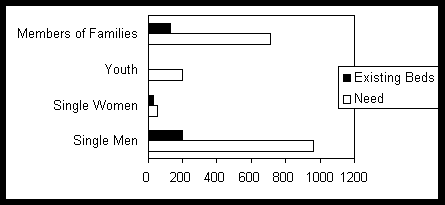
The basic fact now is that we are not meeting our community's needs:
Source: Continuum of Care: Gaps Analysis (Wake County Social Services, 1997)
In spite of dedicated work by a large group of people, Wake County's needs have outstripped the capacity of the present system. Our governments have tried to respond to this need, but have run into resistance every step of the way. Each group is pointing at another to place blame and assign responsibility. This is a costly way not to solve a problem.
There are substantial costs to the present approach.
Our community supports government and non-profit groups that provide shelters, meals and emergency care.
However, the services we are offering are only loosely coordinated and there are gaps in the process between being on the street and being self-sufficient. Without cooperating to build a complete network, we find that instead of offering people an opportunity to become independent, we are just putting most of them back on the street where they will need help again and again.
We lose the homeless peoples' full participation in the community and the economy.
Everyone has something to offer, but when someone slips out of productive society, not only do we pay the social-service costs, but we also lose their productivity. We pay for everyone's failure twice.
There is human degradation associated with begging, and this creates fear and annoyance.
The degradation obscures the humanity and when we feel fear... we pay a third time.
Then there is a loss of business where the homeless gather,
and when we avoid the homeless, we loose these shops, restaurants and parks, thus paying a fourth time, and of course, then the shopkeepers pay a fifth time.
We need a process that takes care of the people who are not able to care for themselves; helps people who have been productive become productive again; and assists people on the difficult journey to independence each step of the way until they succeed.
First Home provides our answer.
The First Home Solution involves a series of seven care centers in our community -- five in Raleigh and two in the rest of Wake County. Each of the centers will be small, housing no more than 50 people. The First Home centers will be located in institutional or industrial settings, not in residential commercial or business areas.
But why are small centers preferable to large shelters?
First, small centers are more easily accepted.
Small centers lend themselves to specialized programs.
Each person on the street got there a different way, and there are different paths off the street, as well. Small centers with specific programs can focus on specific needs and can identify and help people down a road that will work for them.
Volunteers are more willing to serve in small centers
Experience has shown us that volunteers in the community are ready to lend a personal hand to help people in need, but they are not willing to dole out impersonal aid.
Small centers promote personal contact between guests and staff
The success of any program is dependent upon people reaching out to people. We need small, personalized centers to promote this contact.
Our local governments have done their homework. Over the last few years the County, the City, and the advocates for the homeless have worked together and produced plans to meet the community's needs. In each case a coordinated set of small centers is preferred, and they always include:
Key Design Features.
There are separate facilities to serve the needs of men, women, and families.
The different centers have different programs so people can find a program that will work for them.
The county will coordinate the programs among the centers so that a complete set of programs meets the community's needs. After each district committee selects a site it will meet with the county to choose a program for its center.
Public transportation is available, and the centers are linked by vans.
Access to the First Home Centers requires participation in the programming, except in emergency conditions.
While plans have been made time and time again, two things were always missing: support for a site to build on, and consensus that everyone must chip in to make the process work. In order for us to feel confident that these centers can work, and to gain our support, they must take the needs of the whole community into account -- both the homeless and those of us with homes and businesses. These conditions must be met…
The programs must discourage hanging out in the center's vicinity.
The centers can not be focal points for hanging out. We can't provide breakfast and then say "hang out in the neighborhood till lunch". The center and its program must be responsible for its guests. The people in the surrounding neighborhoods must have a voice on the board and be involved in running the center.
The centers are the responsibility of government in partnership with neighborhood associations, churches and other non-profits.
This is one of our key points. Each district needs people that it trusts to be on the board and to help run the center. Each district needs to attract volunteers to work in the center and be aware and be part of what is going on. The churches came together in 1981, and are still working together today. The churches in our districts can work together to help the County run centers that will be assets to our community.
A crucial problem is where and how we locate the centers?
A difficult problem is finding the place -- there is no best place, but each Council District in the City and two in the County must find a site and do their fair share.
The sites must be selected by the decision of the people in each district.
After this plan is adopted each district will have 90 days to locate a site in their district. As the site selection progresses interested people in the surrounding areas will be encouraged to join in the decision making process which will always be open and inclusive.
The sites must be spread throughout the City and County.
Centers must be located in safe, well-lit areas, other than residential, commercial, and business districts, ideally they will be located close to jobs.
Centers must be appropriately spaced from one another and from transitional housing.
There are obviously other important considerations in locating a site, but the people in each district must voice their concerns, show their compassion, weigh the needs of the community, and the needs of the homeless in the community, and choose a site that will work.
We are asking you to adopt the First Home Solution, including:
Small centers with 30 to 50 beds
Small centers can be good neighbors. They must be well run, and well sited. Our community -- all of us -- will be better off if the homeless have a place to stay.
Seven centers--one in each City Council District and two in the County
Everyone needs to feel that the responsibility is being shared. The challenge is everywhere. There are people begging out in the suburbs; there are homeless living in the woods and along the creeks throughout the city. In addition, centers scattered around the County offer a greater opportunity to be near jobs.
Citizens in each district select their center's location, serve on its board, and have a voice in operating it.
The County government works with churches, neighborhood groups and other non-profits to run the centers.
This is a bottom-up approach that encourages volunteers, and allows citizens who are near centers to be involved in the programming and have a voice in its operation. While sometimes it can be difficult to take competing needs into account, this is a necessary part of being accepted into any community. You may not feel that an overworked government employee is going to care about your concerns, but you know that the pastor of your church cares.
All of the centers must have program plans that are based on sound models
This is another key to First Home success. We have read excellent plans proposed by Wake County as well as Friends of the Homeless, and there are other successful programs in North Carolina, and around the country that we can model our programs around. With local involvement we can be sure that the programs will not only help the homeless, but fit comfortably into our community.
Each center serves a specialized need.
By building a network of centers throughout the community we will create a process that will help people who have nearly lost hope get back on their feet. Remember what it is like when a cluster of problems crashes down on you. Imagine how devastating that must be when it leaves you homeless and hungry. These seven centers, combined with the small well-run private shelters we already have, can fill in the missing steps that are necessary to help a homeless person become self-sufficient.
This plan is a framework for action. We will need interested people and elected officials from each district to serve on district planning committees with County and City staff, and they need to attract other organizations such as churches to join them. The site selection must be open and considered with respect to the programming. In addition the district plans must coordinate with a master plan so a network without gaps is produced.
This will not be an easy task. But the existing situation is not any easier, and in the long run it is more expensive. When we fill in the gaps we will have a process that helps people become productive so they can earn their way out of the system, and into the community.
We welcome your insight, and look forward to discussing this proposal to improve it and develop strategies for implementing it. Please feel free to call or e-mail any of us.